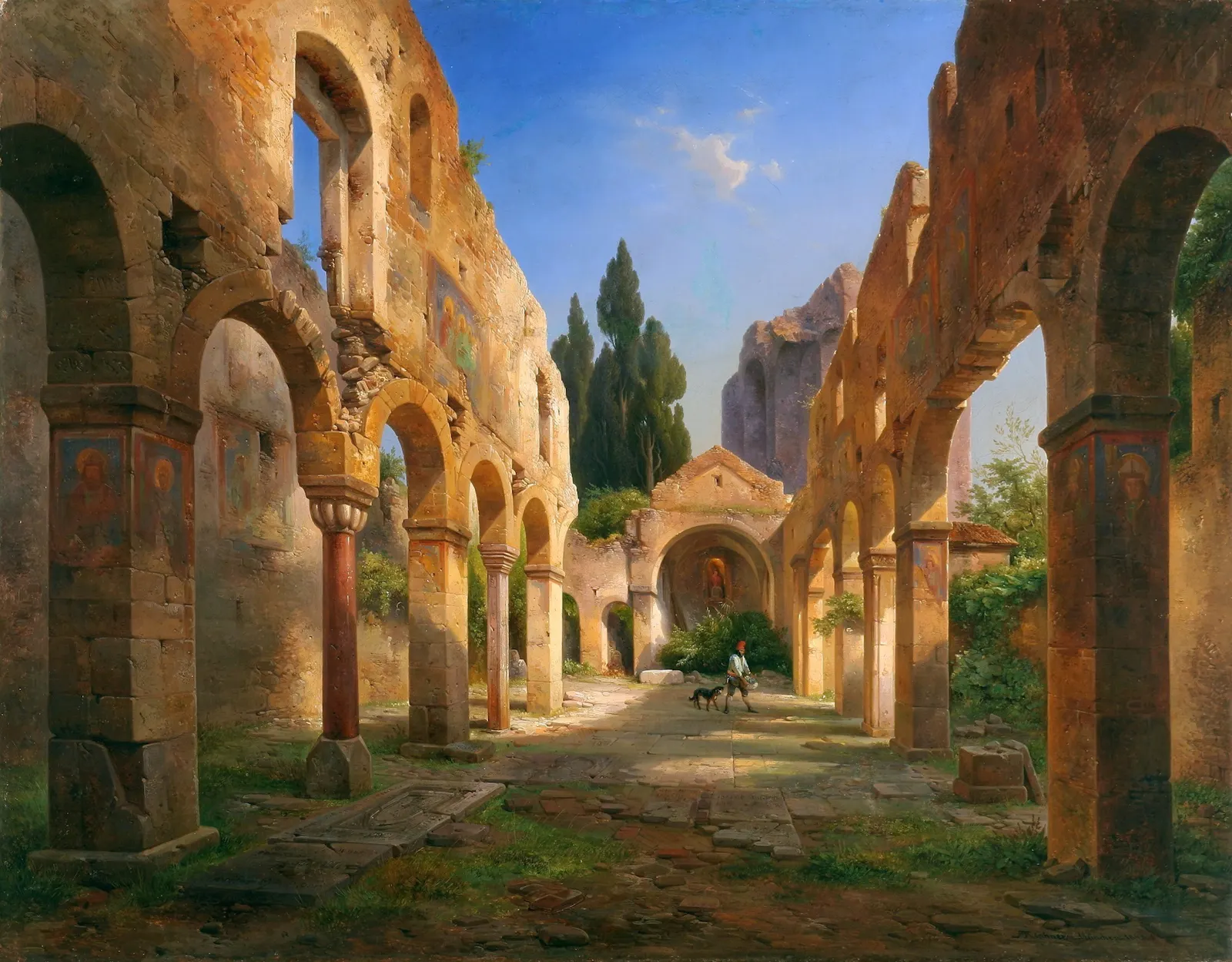
Introducing the Public Domain Art Portal (PDAP) by Studio Slowcore
MARCH 28TH, 2026

(Editor's Note: This is an updated and lightly edited version of the original post on Substack to introduce the project in Dec. 2025. The project didn't work well on Substack, so we're glad to give it a new home in our Dark Forest).
Main image: Basilica at Castello S Pietro in Verona - oil painting by Albert Emil Kirchner (1845) - source: Wikimedia Commons
Table of Contents
-
The Story So Far
-
Curation Generates Value. But Where Does That Value Go?
-
A Gentle Inquiry: Where Do We Place Our Attention? What Do We Notice?
-
The Public Domain Art Portal: What To Expect
“To study old art is to study different values and pleasures and possibly keep some of them for your own… as true for painting as for literature.“
~ Simon Sarris
Welcome to the Public Domain Art Portal (PDAP) by Studio Slowcore — a project that got its start as a daily short-form post on Farcaster, moved to Substack, and is now taking root in our Dark Forest, aka our new space in the Dark Forest Operating System.
The Story So Far
The Public Domain Art Portal first took shape in late March 2025.
But I didn’t know it at the time.
After coming to terms with the poor prospects for “earning a living” in web3 contexts, I (Danica) had just started a three-month certificate class in grant writing with the intention of forging a new path toward a sustainable livelihood.
I wanted to keep posting something interesting to Farcaster daily. In addition to the social connections I’d made there, this was back in the days when Merkle Manufactory (the company that owned Farcaster at the time) was paying weekly $USDC rewards to creators whose work attracted certain levels of engagement. I earned $10-60 per week that way for many months.
But I figured most of my cognitive bandwidth would be occupied with grant writing studies and related matters, so I doubted I’d be able to keep posting frequent long-form social media text that met my usual standards.
That’s how I came up with the idea to dig into my collection of public domain art images, and share one new piece every day — with proper sourcing, of course, so readers could always verify the provenance for themselves.
When I started collecting public domain art about 20 years ago, I had no intention of building a curated collection with themes. I had no objective other than saving beautiful images I thought I might want to use in blog posts, or print out and frame.
I loved looking through public domain art. I found at least 1-2 pieces of art I deeply appreciated in almost every rabbit hole where I started digging. So my collection kept expanding.
Shortly before I began the grant writing class, I checked my files and realized to my surprise that I had enough images stashed to enable me to post something new every day for at least 2-3 years, without even looking for anything new. I knew I could make daily bite-sized posts with no more than 5-10 minutes of effort, even on low-energy days.
So I started doing just that.
Then in late April 2025, something dropped into my lap unbidden… after I had reluctantly given up looking for ways to make a living in the “Farconomy” and turned my attention elsewhere (i.e., to the grant writing class).
That something was the seed-vision that became Studio Slowcore, in which we “move slow and preserve things.”
Curation Generates Value. But Where Does That Value Go?
Calling attention to obscure-but-worthwhile human-curated art seemed like a worthwhile endeavor, especially with the rise of slopular culture.
The daily public domain art posts attracted a lot of appreciation. People started complimenting my tastes, asking questions, leaving tips, calling me a “resident public domain art appreciator,” tagging me in related conversations, calling my attention to upcoming releases of public domain works, and mentioning that the project inspired them to start sharing their favorite public domain art in similar ways.
So without even trying, I’d stumbled upon a role that enabled me to
-
provide a valued service to a social network through intrinsically motivated work, and
-
also earn financial rewards — albeit with caveats: only in certain Farcaster contexts, for a limited time, and in small amounts.
Brings to mind a memorable quote from a video by Callum Wanderloots:
“Find people who are deriving value in a way that they’re willing to spend their attention on you.”
I like to apply this framing to public domain art projects. It suggests that the people “spending their attention” on the creative work (i.e., the viewers, lurkers, or readers) should be “deriving value” from those expenditures of attention… right alongside the artists (whose expenditures of attention bring the work into being), the preservers (whose expenditures of attention help keep the work accessible), and the curators (whose expenditures of attention highlight the work as something worthy of further attention).
(For a deep dive into related ideas, see Curator Economy, Not Creator Economy by Tom Beck, and the community discussion spawned by Tom’s essay).
People clearly valued the curation of public domain art — they were “spending their attention” on it — and I too found the work valuable and worthy of closer attention for a long list of reasons.
So I continued posting the art daily, even after the class ended.
But there were still plenty of unanswered return-on-attention questions.
Why, even on Farcaster — a social media app which ostensibly values creators — was the vast majority of the return on this attention still going to the tech companies, with so little ending up in the pockets of the curators, artists, readers, and viewers whose attention generated this value?
Could more of the return on this attention be directed away from extractive platforms, and channeled into grants or gifts to fund curators and others who contribute value to the commons through creative scenes and networks?
Could I generate a more sustainable level of “curator income” this way, yet still keep the work intrinsically motivated, and avoid turning it into jobbing? (For the uninitiated: I have a 25-year history as an advocate of anticareerism, aka unjobbing).
What did the Studio Slowcore seed-vision want to become, and could the public domain art project be included?
The context is smarter than us, after all.
While pondering these questions, I received multiple requests for a newsletter or blog version of the public domain art project.
So when Studio Slowcore decided to move our control room for the Return On Attention group chat onto Substack in October 2025, I decided to experiment.
Turns out Substack wasn't the best home for it, however. It works best as a simple daily share, with its own specific contexts and flow-patterns that emerge over time depending on whose attention it attracts.
When the Dark Forest Operating System became the new HQ for the studio in early 2026, I moved it to a new home.
You're now reading it as it appears in the Studio Slowcore Dark Forest.
A Masque for the Four Seasons - oil painting by Walter Crane (1905-1909) - source: Wikimedia Commons
A Gentle Inquiry: Where Do We Place Our Attention? What Do We Notice?
Public domain art is deeply rooted in gift culture. Many public domain works are still creating enormous value (gift + market value) hundreds of years after they first surfaced. Through careful curation by trusted humans, further attention can be directed to that kind of enduring value.
For Studio Slowcore (a hybrid gift + market venture), the art often inspires a gentle ongoing inquiry into the placement of human attention. For example, we can ask ourselves:
What do we notice when we give sustained attention to the art?
What happens if we change where we place our attention in relation to the art?
What stands out?
What fades into the background?
What, if anything, does the art give back… or give forward?
Does the art offer a worthwhile return on our attention?
What happens to enduring art in a world that extracts so much of the gift value generated by our attention and turns it into market value, with little financial reciprocity toward the artists and value-generators?
Could we find ways to reverse the extractive process — i.e., turn profit into gift — as a way to help create an environment that fosters sustained attention?
About that last one: we don’t know. But let’s see what we can do when we release our best work from within the shelter of the Dark Forest.
The Public Domain Art Portal: What To Expect
The Public Domain Art Portal is a gentle open-ended daily inquiry into the placement of human attention, and an affirmation of enduring forms of value.
It's curation-by-slowcore-ethos.
Everything is curated with care and sustained human attention — key components of what we think of as slowcore value.
Our long-term aim is to produce a library of evergreen posts on public domain art that you can savor at your leisure and revisit through our Dark Forest.
We'll leave room for patterns to emerge over time. Thus the name “portal”: we don’t know where this work will lead, but we’ll course-correct as necessary whenever we get trusted signals from the work itself.
A Dance of Shepherdesses - book illustration by Charles Edward Wilson (1881) - source: From Old Books Dot Org
On sourcing: as the proliferation of AI makes it more challenging to find reliable sources of info about the art — for us non-art-historians, at least — it’s worth taking time to double-check facts and preserve as much accurate info as possible. If the info can be verified with multiple trusted sources, even better. We appreciate error corrections from our readers.
Old book illustrations, for example, can often be a goldmine for outstanding public domain art with verifiable provenance.
Ideally the art will find its way to those who appreciate it enough to contribute to curation and preservation efforts of all kinds.
If that’s you, be sure to check our image captions for links to sources. You can often buy high-resolution downloads of public domain art for very reasonable prices. Every purchase counts, since many of the lesser-known art preservation projects are managed by one or two people on a shoestring budget.
Screenshot from a section of the Public Domain Art Room base view in Danica’s Obsidian vault
Themes
Based on patterns in the studio’s collections so far and Danica’s boards on Pinterest, here are a few themes you can expect:
-
Classical living
-
Pre-Raphaelite women
-
Germanic Mythology
-
Dancers
-
Architecture
-
Liminal spaces
-
Conifers (i.e., evergreen trees)
Horizons: Future Possibilities
-
Digital collectibles (e.g., mood boards)
-
Pairing public domain art with public domain poetry
-
Guest posts
Looking forward to connecting with other appreciators of public domain art!
Dryburgh - watercolor by William Smith (1904) - source: Art UK


